Marker Learning
Time to magic
What happens when the problem you set out to solve isn't the real one.
Role:
Senior Product Designer
Team:
Product Manager,
Engineers,
Visual Designer,
UX Writer
Duration:
2 months
OVERVIEW
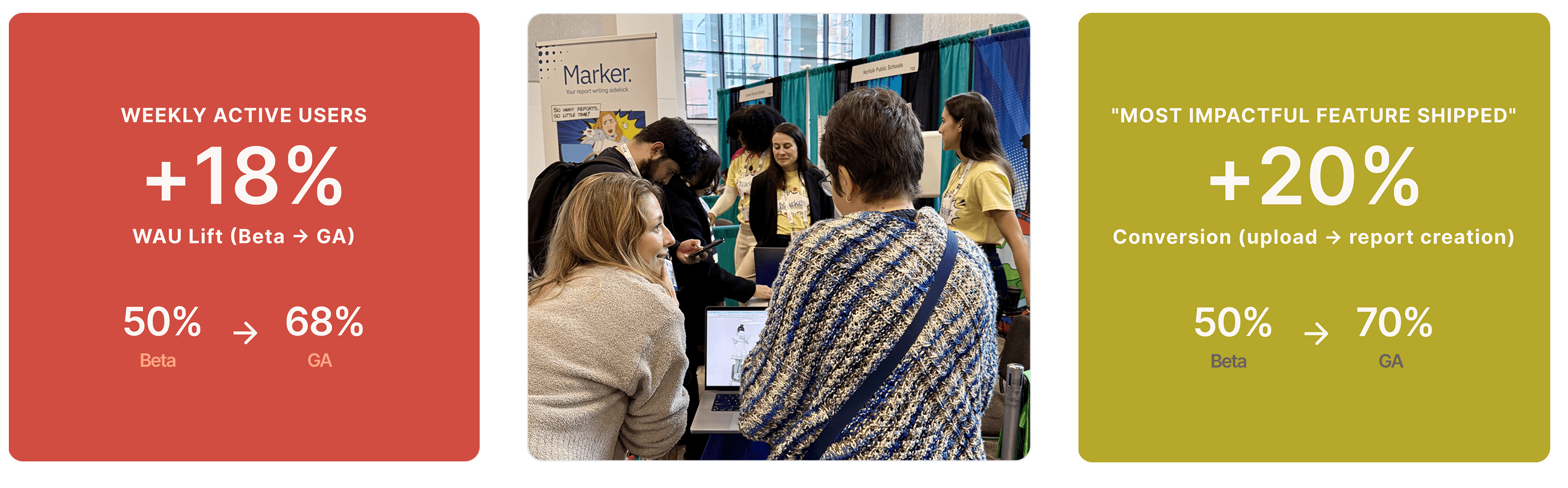
Time-to-Magic is an LLM-powered feature that automatically categorizes referral documents the moment they're uploaded, eliminating over an hour of manual sorting before report writing can begin. It started as a different feature entirely. Here's how user research reshaped it into Marker's most-used tool, and drove an 18% increase in weekly active users from Beta to GA.
WHAT’S MARKER?
Special education reporting made faster, clearer, and more compliant
Marker helps school psychologists conduct faster, more accurate Learning Disability evaluations. Only 5% of students with a learning disability actually receive a diagnosis. Marker exists to close that gap.
But faster evaluations don't start with better tools. They start with a workflow that fits how psychologists actually work. The original product didn't.
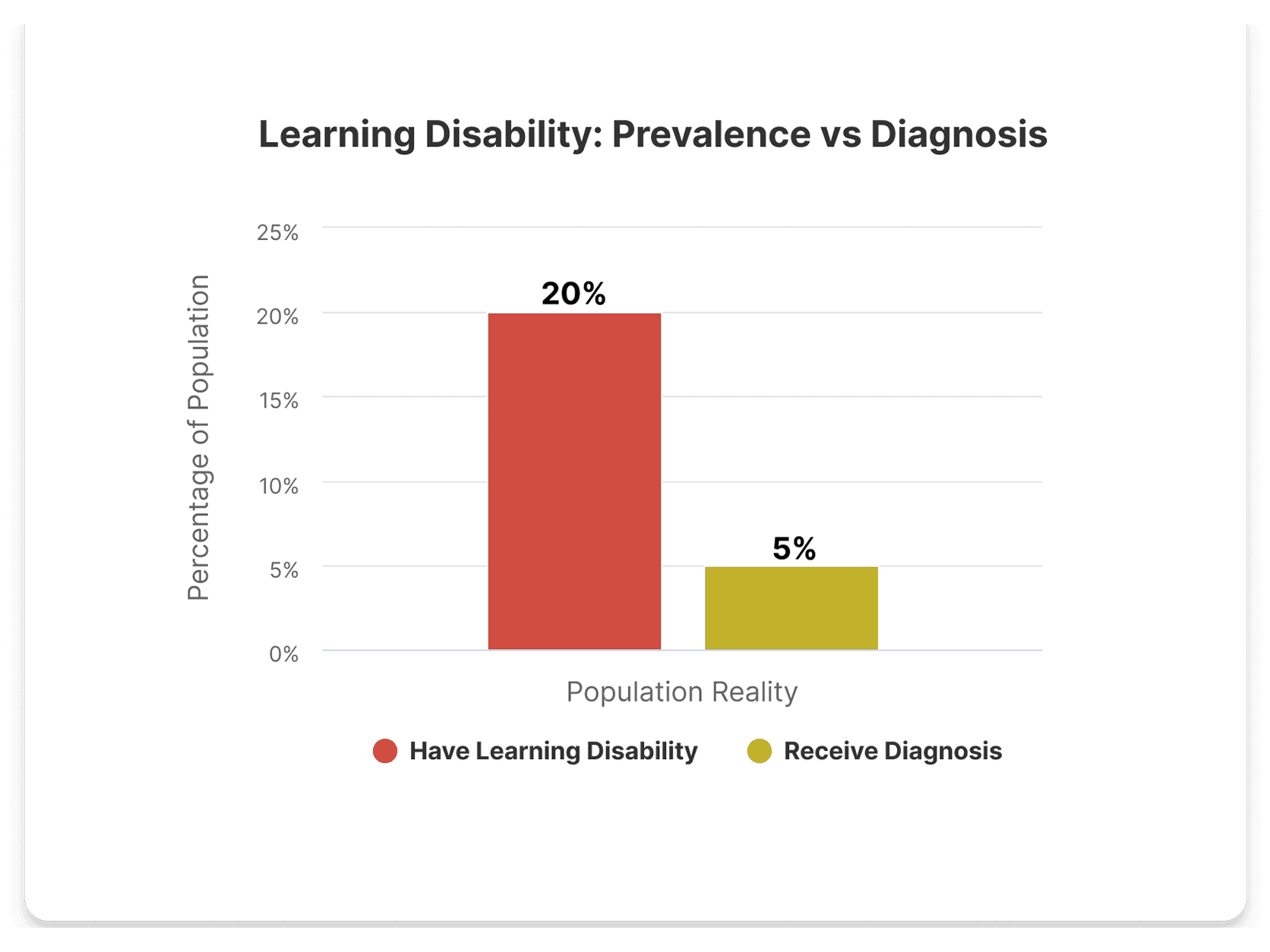
Here's what it got wrong.
PROBLEM
We thought the pain was redundant data entry.
Before psychologists could start writing a report, they had to add the student to their caseload: name, grade, district, demographics, referral reason. Then they'd upload the referral documents, which already contained most of that same information.
Our read: they were entering data the system could extract. Cut the manual step, pull student info straight from the documents, and get them to report writing faster.
The brief was straightforward. Eliminate the double work.
WHAT WE GOT WRONG
We started by solving the wrong problem.
Our first hypothesis was about speed. If psychologists could skip student entry entirely and jump straight to document upload, we could auto-pull student info from the referral packet and cut a step. I prototyped it in Figma and ran it past users.
Their first reaction was encouraging. "That's pretty cool." But the moment I asked how it would fit into their week, the idea fell apart. Psychologists almost never had documents ready when a new case landed. They added students to their caseload first, sometimes weeks before a referral packet arrived. The step I was trying to eliminate was the one step that actually matched their timing.
Digging deeper revealed the real bottleneck. Once that packet did arrive, it was 80+ pages of disorganized documents from multiple stakeholders, and every psychologist described the same coping mechanism. They mentally sorted the packet into a "manila folder" of categories before a single word of the report could be written. That sorting was invisible work, and consistently one of the most draining parts of the job.
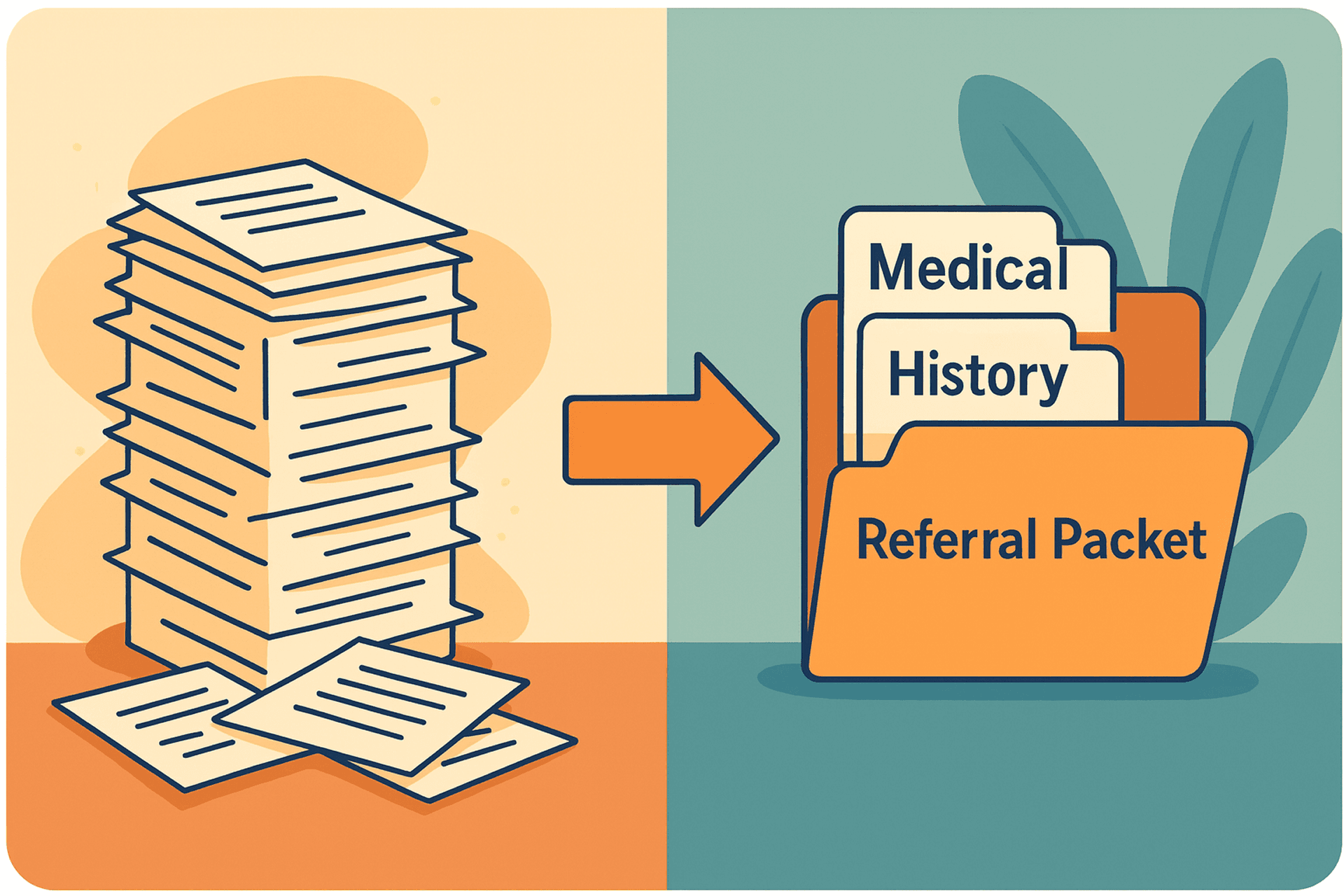
The pain wasn't entering a student. It was everything that happened the first time they opened the packet.
That reframed the work. The right design wasn't to replace their mental model. It was to match it.
SOLUTION
Instant structure the moment a referral packet lands.
As soon as a referral packet is uploaded, Marker's LLM automatically categorizes every document, giving psychologists an immediate sense of what they have, what's missing, and where to start.
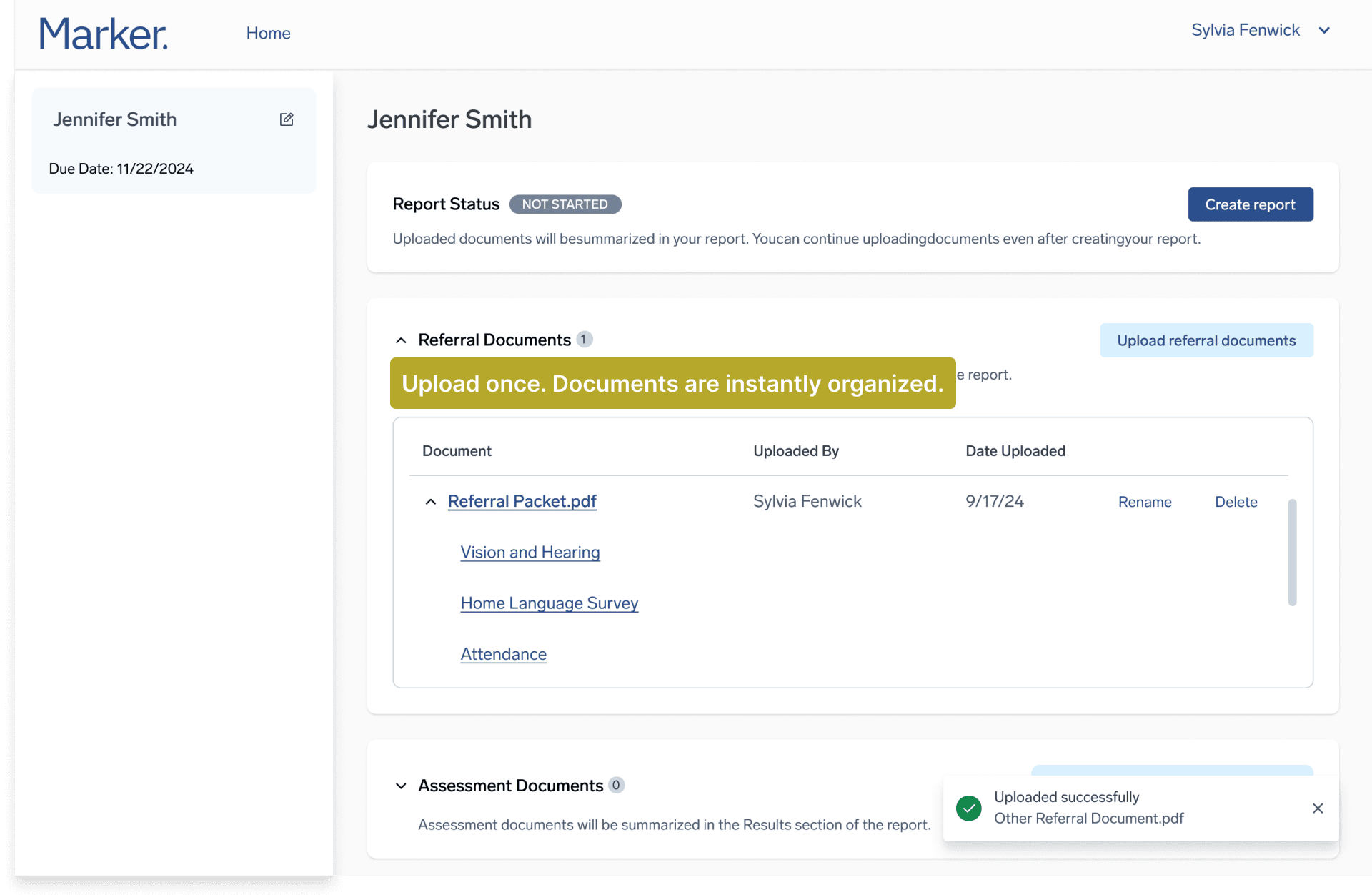
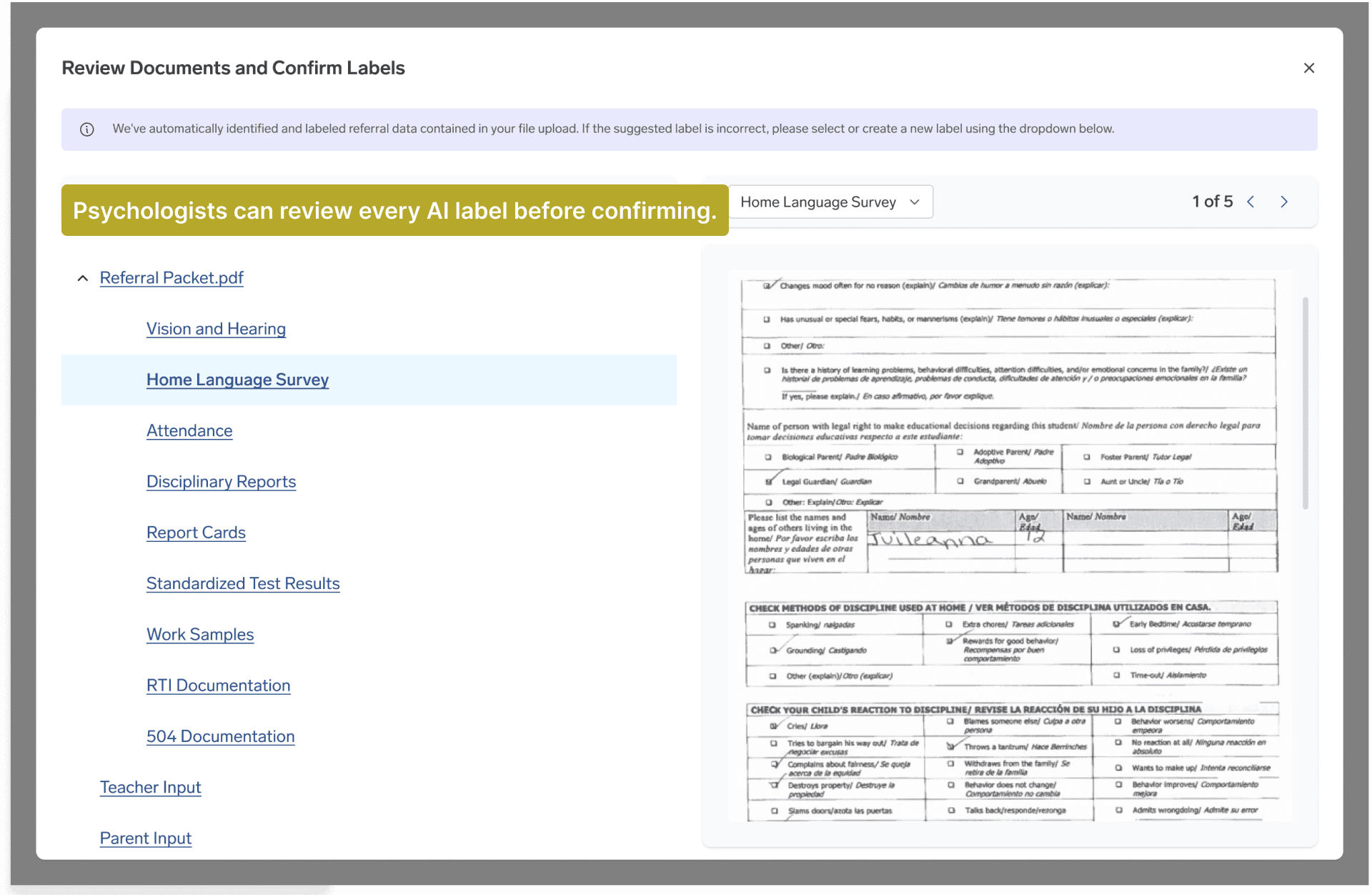
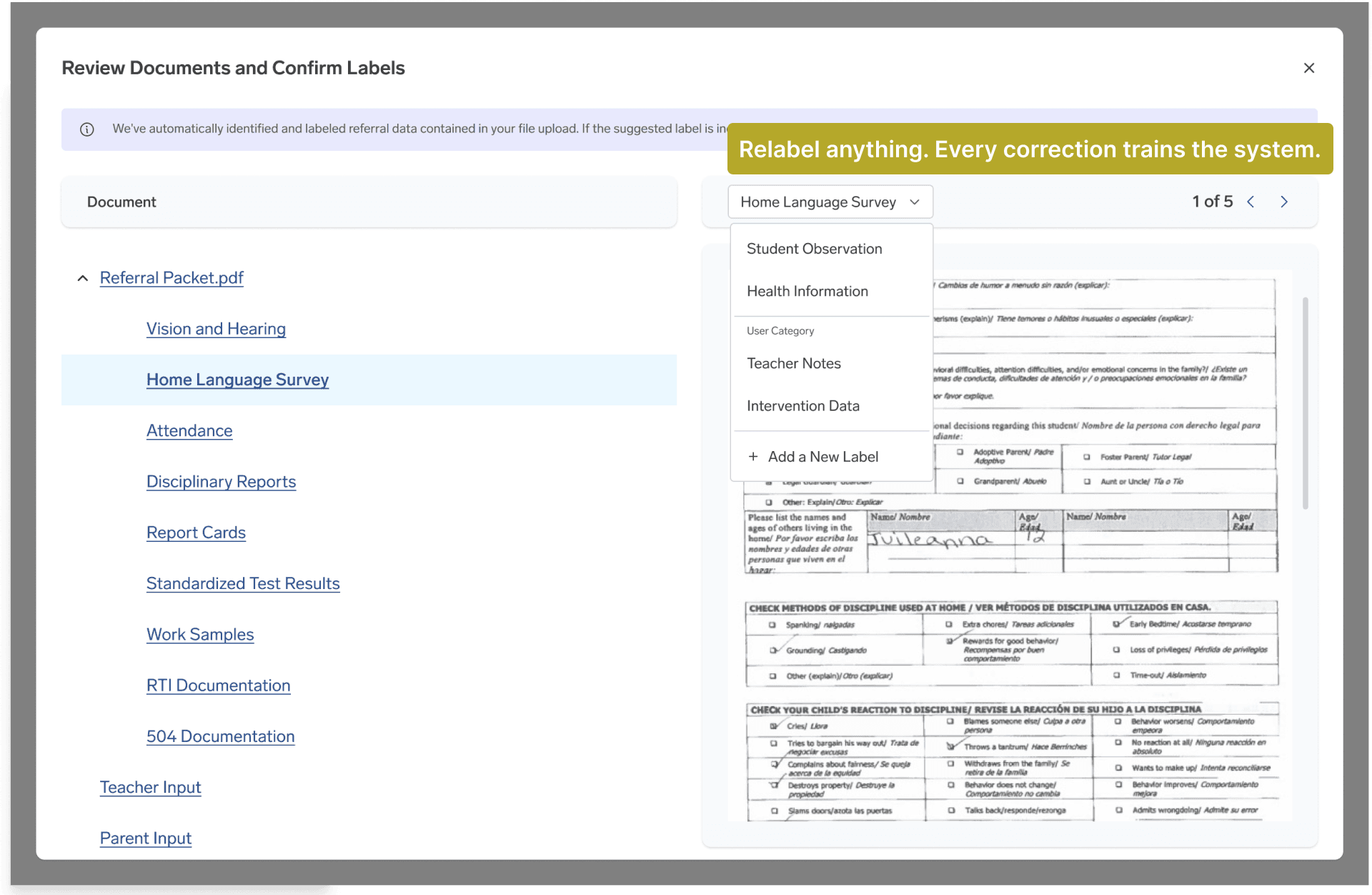
Every correction did double duty. Psychologists got the control they needed to trust the output, and each relabel fed back into the model, improving categorization accuracy on future packets. The review step wasn't just a safety net. It was a training signal.
But the launch wasn't the finish line.
ITERATIONS
The feature worked. Nobody knew it existed.
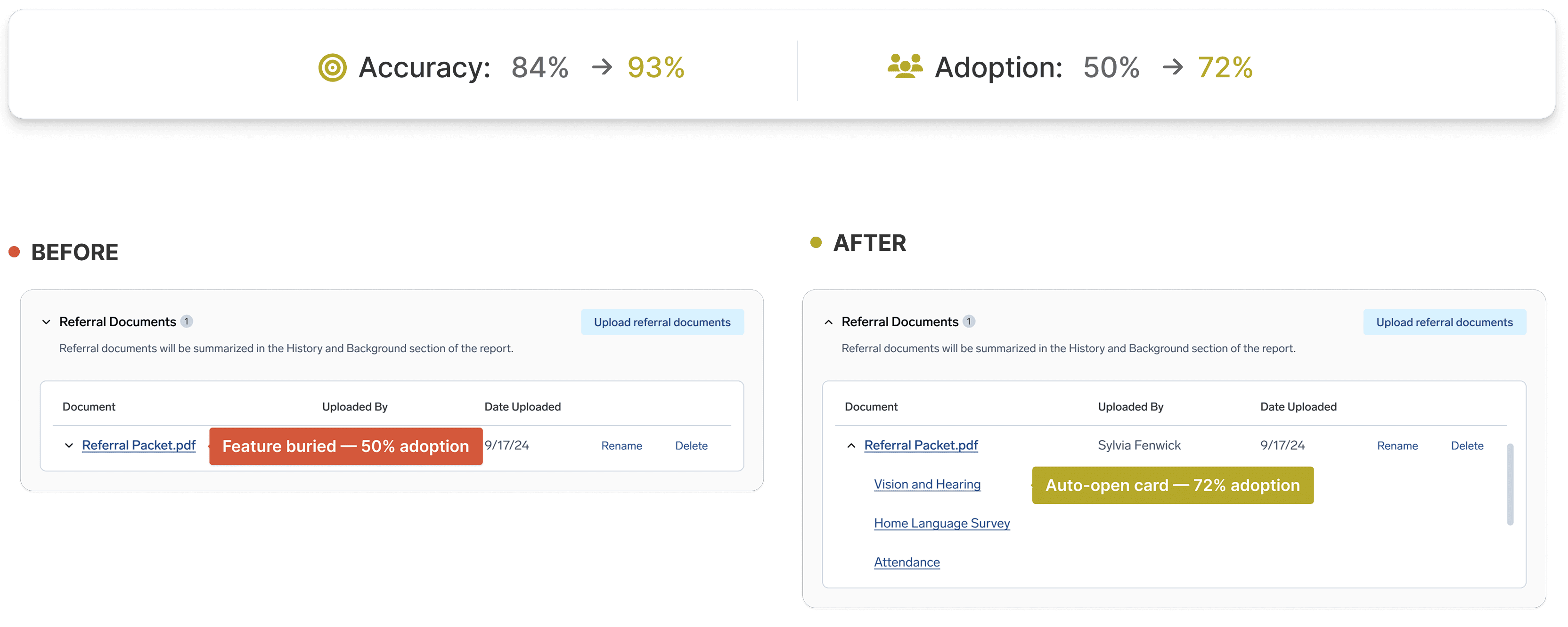
Categorization accuracy hit 84%, exceeding our 80% goal. But adoption was only 50%, well below our 65% target. The problem wasn't the feature. The card was collapsed by default, so users uploaded packets and moved on without ever seeing what the system had done for them. One change fixed it: auto-opening the card on upload. The feature's value was instantly obvious.
A second fast-follow fixed a multi-page context limitation in the model, lifting accuracy from 84% to 93%.
RESULTS
Strong adoption validated the approach. It set a new bar for AI at Marker.
Time-to-Magic became Marker's most-used feature. It was named the most impactful shipped by the team and consistently generated "oh wow" moments at NASP conference demos. It proved that reducing friction at the right moment, not just automating for speed, was the right direction.
REFLECTION
The best AI features match how users already work. They don't ask users to work differently.
Time-to-Magic started as a time-saver and ended as something more useful. Not because we shipped the original idea faster, but because user research pulled us toward a workflow that already existed inside every psychologist's head. The manila folder wasn't a metaphor we invented. It was a mental model we learned to respect.
Three things this project reinforced:
Match the mental model, don't replace it. The feature worked because it matched how psychologists already organized a case. Automation didn't ask them to think differently. It accelerated the thinking they were already doing.
Listen past the first reaction. Users said "that's cool" to our original prototype. It took a second round of questions to hear that "cool" didn't mean "useful." The best insight came after the obvious response.
Ship to learn, then design for the moment that matters. The first version hit 84% accuracy and 50% adoption. Both improved through iteration, but only because we shipped early enough to learn where the real friction was. The "wow" moment wasn't the categorization itself. It was the instant a chaotic 80-page packet became something a psychologist recognized.